

Exchanges that used to transact 1 000 bitcoin a day are now doing 50. But while crypto transactions have collapsed, stablecoins have picked up the slack, says Carel de Jager, CEO of crypto data analytics firm Silver Sixpence. From Moneyweb.

You can also listen to this podcast on iono.fm here.
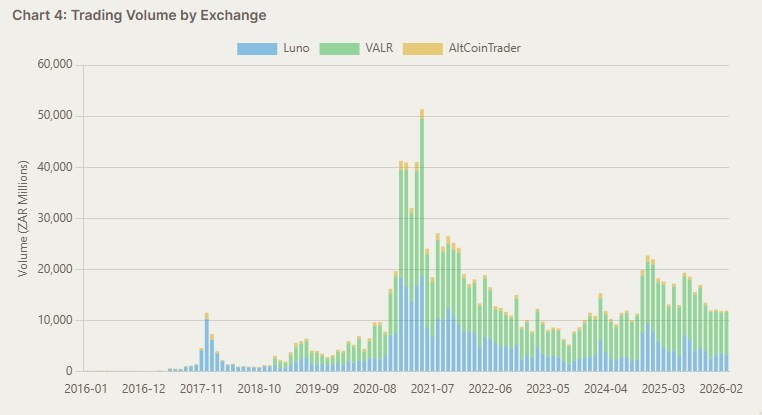
Crypto volumes on SA exchanges are down 95% over five years. The two largest exchanges – VALR and Luno – used to transact around 1 000 bitcoin a day at the height of the previous bull market in 2021. Now they’re doing about 50 a day.
That’s according to says Carel de Jager, CEO of crypto data analytics firm Silver Sixpence, which monitors crypto trading and patterns on SA exchanges.
“It’s a little bit sad,” says De Jager, speaking on the Moneyweb Crypto Podcast.
“I don’t like seeing such a big decline in volume. This industry used to be booming. It used to be extremely exciting. I’m not saying it is not anymore, but I am saying that the sentiment, at least if you look at that kind of data, has declined.
“And I’m wondering why. If that is attributed to regulations, then I think we need to ask ourselves some very hard questions,” he says.
“Do the regulations achieve its mandate in protecting consumers? If it does, then that’s great. If it does not achieve its mandate, but we’re still seeing a decline in volume, is that because of these stringent regulations? And if that is the case, then we have to reflect a little bit. Aren’t we stifling the industry?
“Being an on-chain and data analytics expert, I am very much lobbying for the regulator to have tons and tons of data to monitor this industry so they can be comfortable.”
Source: Ledgercore.io
The more tools and data the regulators have, the better the decisions they will make. But there’s no denying that crypto volumes have collapsed, and the number of new entrants to the market has withered.
De Jager says enthusiasm for crypto tends to follow the price cycle, which has been in freefall for the past few months. But that doesn’t explain the scale of the drop-off in volumes.
One measure of this is the bitcoin (BTC) arbitrage trade – there used to be a 4-6% premium when buying BTC on SA exchanges. Thousands of people made money buying BTC abroad and selling it locally at a profit. That premium has dwindled to less than 1%.
“That means that there is more than enough supply now to satisfy the demand,” says De Jager. “And at volumes that we’re currently seeing now, that basically means the denominator, the demand is very, very low.”
Stablecoins are the new engine in the crypto market
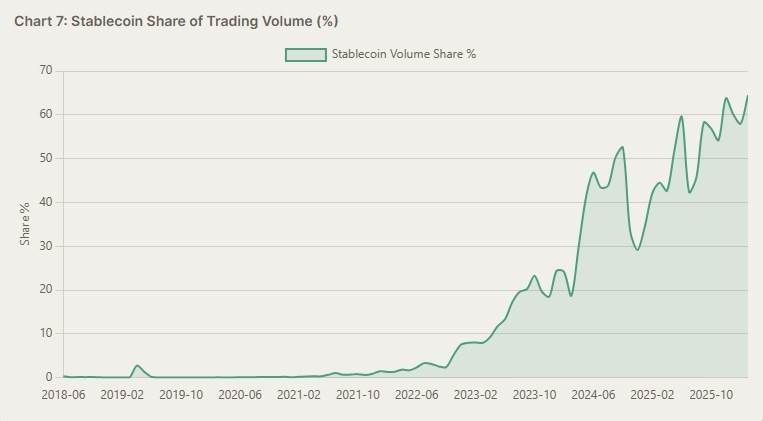
Crypto volumes may be down, but stablecoins are picking up the slack on local exchanges.
That, says De Jager, is true for VALR, and the stablecoin of preference is Tether (USDT).
“VALR attracts a very niche type of customer, a customer that is looking for very high volumes of USDT. They [VALR] have some very good market makers on their platforms that are able to supply and create a very efficient order book for the USDT pair.
“So that’s fascinating to see. And yes, we’re talking hundreds of billions of rounds of USDT trading volume still on VALR per annum. So it is significant and it’s good to see.”
Source: Ledgercore.io
The reason for this explosion in USDT trade is the utility that comes with it, such as cross-border remittances and payments.
Banks make their move into crypto
There’s massive innovation happening in all SA banks around stablecoins, institutional products, custody, brokerage and insurance products. Several US banks have launched their own stablecoins, and that innovation is now spilling over into SA.
“2026, so far, has been the year of the stablecoin. I expect this trend to only increase for the rest of this year. And then I’d like to predict that 2027 will be the year of asset tokenisation.”
The same kind of innovation seen in stablecoins from the banks and large institutions in 2026 will morph into huge developments around asset tokenisation as we head into 2027.
That’s where previously illiquid assets like real estate, private credit, commodities, fine art and luxury goods provide backing for tokens that are then freely traded on exchanges.
Tokenisation will also make it quicker and easier to launch projects such as bond issues or provide financing for infrastructure development.
There are some players who jumped the gun on tokenisation that then failed. It’s all about timing, says De Jager.
“If the market isn’t ready and you cannot survive until the market is ready, then unfortunately, you’re going to burn your way through your runway. And unfortunately, you’re not going to make it. We’ve seen lots of precedent regarding that. Timing is everything in this market. Now is the time for stablecoins. Next year will be the time for asset tokenisation.
“So take that and build it into your roadmap. You can quote me on that if you’d like. But timing is everything. I think brokerages have had their day. Exchanges have had their day. There’s plenty of liquidity now and plenty of brokerage platforms. These things come in waves. Brokerage is one of them. Custody – I don’t think it’s worth innovating in that at all, in my opinion.”
Eskom goes bitcoin mining
It’s been speculated that Eskom would use its spare generating capacity to mine BTC.
De Jager was the first to bring this to Eskom’s attention.
Surprisingly, this struck a chord with Eskom, and some important developments are expected in this regard in the next few months.
“There’s some real stuff happening and we’ll see them [Eskom] getting into the bitcoin mining space soon. And I think it’s extremely exciting. Bitcoin mining brings so many benefits to electricity utilities like Eskom.
“It stabilises the grid because of the ability for a bitcoin mine to fluctuate its demand profile in extremely fine increments,” he adds.
“It’s a huge power consumer that is able to reduce its power consumption from many hundreds of megawatts to zero and then increase that in a matter of milliseconds.
“That’s a type of demand response that has never been available to a national electricity grid. And if you couple that with AI, which is extremely hungry for electrons …
“Power availability is the biggest bottleneck for the AI revolution. But the problem is the power profile of an AI data centre or hyperscaler.”
