
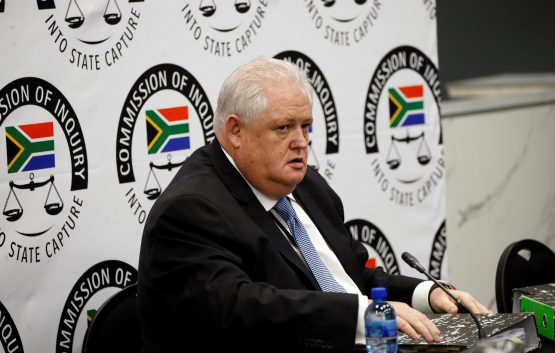
His testimony at the Zondo Commission helped blow up a R12bn empire built on graft. From Moneyweb.
Former Bosasa chief operating officer-turned-whistleblower Angelo Agrizzi has cut a deal with the state to avoid incarceration for being part of a corrupt syndicate that bribed officials, including ministers.
In return, he will have to provide honest testimony to the National Prosecuting Authority (NPA).
Read: Angelo Agrizzi blows Sars in R174m tax case [Jul 2023]
Agrizzi – now in poor health and on an oxygen machine most of the time – initially offered to assist the state back in 2019, but that offer was spurned.
Agrizzi approached the commission after his approaches to numerous law enforcement officials and parliamentarians fell on deaf ears.
The plea and sentence agreement with the Investigating Directorate Against Corruption (IDAC) sentenced Agrizzi to 10 years’ imprisonment, wholly suspended for five years on various conditions, including that he commits no further offences.
Agrizzi pled guilty to three counts of corruption and one of money laundering.
He will be required to provide “continued and truthful cooperation” to assist the NPA in its “ongoing investigations and future prosecutions against other high-level individuals implicated in the Bosasa corruption network”, says IDAC.
The latest deal with the state appears to be one of the fruits of SA being removed from the Financial Action Task Force (FATF) grey list.
A commitment made by SA to the FATF was more aggressive pursuit of corrupt officials – something noticeably lacking during the state capture years.
Testimony
Agrizzi spent 11 days in the witness box at the Zondo Commission of Inquiry Into Allegations of State Capture, which found his evidence “crucial in uncovering the decades-long practice of bribing officials to win tenders” by Bosasa.
The evidence included hundreds of cash payments to senior government officials, detailed in a black book he kept, as well as video evidence of bags being stuffed with cash. His testimony was given added heft by his insider’s knowledge of the inner workings at Bosasa.
The commission found his testimony “mostly truthful” and largely credible, while acknowledging that his motives for coming forward were not entirely altruistic.
There had been a major rupture in relations with former Bosasa CEO, the late Gavin Watson, which appears to have played a role in Agrizzi’s decision to turn whistleblower.
Agrizzi countered that he had been offered – and refused – a R50 million bribe, allegedly from the Watson family and others, to stay silent.
Read:
Gavin Watson into the void [Aug 2019]
Nomvula Mokonyane, Bosasa, and all those repairs [Jul 2020]
The commission pored over tens of thousands of pages of evidence and hundreds of hours of testimony, principally from Agrizzi, that the organisation’s business model was built on corruption and bribery, rather than occasional instances of misconduct.
Systematic corruption at Bosasa
Bosasa (later renamed African Global Operations) was a facilities management company providing services to the Department of Correctional Services (DCS) and, to a lesser extent, Home Affairs.
An estimated R4-6 million a month was paid in cash bribes to about 80 individuals, including government officials and politicians.
The bribes sometimes came in the form of cars, holidays, and payments for security upgrades on homes. Agrizzi named ANC royalty on the Bosasa bribe list, including former president Jacob Zuma, who allegedly received R300 000 a month, channelled through the Zuma Foundation.
Also named was Gwede Mantashe, current Minister of Mineral Resources and Energy, who is alleged to have received about R300 000 in security upgrades to his properties from Bosasa. The Zondo Report specifically recommended that Mantashe be investigated for corruption based on these allegations.
Mantashe has survived a series of scandals, from his downplaying of the Guptas’ role in state capture, his support of Zuma, and his blunt dismissal of former Eskom CEO André de Ruyter’s claims that the energy utility’s coal supply chain had been infiltrated by criminals.
Read:
Gwede Mantashe tries to explain cadre deployment [Apr 2021]
Bosasa’s ‘Godfather’ Gavin Watson used prayer meetings to test staff loyalty [Mar 2022]
Gwede Mantashe named in Bosasa scandal [Jan 2019]
Mantashe’s resilience is a testament to his power within the ruling ANC, where he forms a crucial bridge between Zuma loyalists and President Cyril Ramaphosa’s reformist faction.
More senior figures named
Another senior figure named by Agrizzi was the late Dudu Myeni, former chair of South African Airways (SAA), who in 2020 was declared a delinquent director by the Pretoria High Court following a case brought by civil society group Outa (Organisation Undoing Tax Abuse) and the SAA Pilots’ Association for dismantling the airline’s governance structures.
The Zondo Commission found she had received bribes from Bosasa and had a hand in trying to stop a corruption probe into the company. The commission recommended that she be formally charged with corruption and fraud for her alleged dealings with Bosasa and her role in obstructing investigations.
Also named was former Mpumalanga premier Thabang Makwetla, who later became deputy minister of Defence, who Agrizzi claimed received security upgrades and maintenance at his house. ANC MP Cedric Frolick was alleged to have received monthly payments from Bosasa – something Frolick has denied.
Read:
Corruption arrests, land sales raise SA spirits [Oct 2020]
Dudu Myeni the recalcitrant witness [May 2021]
Agrizzi continues to implicate political heavyweights [Jan 2019]
Former ANC MP Vincent Smith, former DCS commissioner Linda Mti, and former DCS chief financial officer Patrick Gillingham were also named by Agrizzi as recipients of graft. Their prosecutions are ongoing.
Agrizzi claims Mti and Gillingham were allegedly central to Bosasa’s ability to secure lucrative contracts within the DCS.
The Zondo Commission found that the ANC, as an organisation, had been the recipient of extensive corruption within state-owned enterprises (SOEs).
According to testimony at the commission, Bosasa employees would often write the specifications for government tenders, giving the company an unfair advantage over its competitors.
Gavin Watson: The godfather of Bosasa
The godfather ruling over Bosasa was Gavin Watson, scion of a famous anti-apartheid rugby family, who turned political activism into an empire of graft.
He, along with others in Bosasa, “simply had no shame in engaging in acts of corruption”, noted the Zondo report.
Listen: How Gavin Watson’s death could impact the Bosasa probe [Aug 2019]
Agrizzi’s testimony may, in part, be self-serving, but it has contributed to crucial proposed reforms, such as:
- Increased whistleblower protections, with a proposed Whistleblower Protection Bill expected to provide stronger safeguards;
- Public procurement reforms, including measures designed to stop favoured companies drafting their own tender specifications;
- New SOE appointment reforms, intended to do away with cadre deployment in favour of meritocracy – these are embodied in the Public Service Amendment Bill, now before the National Council of Provinces, and should help curb state corruption;
- Lifestyle audits for senior officials in government departments, which are becoming increasingly common; and
- More ministerial accountability, as shown by parliamentary committees’ growing intolerance of aberrant ministers.
Mti, Gillingham and Smith are the only ones facing charges out of the dozens named in the Zondo Report in connection with Bosasa.
What about the directors of Bosasa who signed off on corrupt tenders? How about ANC cadres and parliamentarians identified by Zondo? What about the companies and private individuals implicated?
The NPA’s work – one hopes – is just getting started.
