There’s quite a list of them in the past few months alone. From Moneyweb.

CEOs are quitting their jobs at an alarming rate – including, just this year, at Eskom, Transnet, Transaction Capital, Tiger Brands, Bell Equipment, Pick n Pay, Nampak, and the Public Protector.
That’s not counting some notable CEO departures in 2022, as at Oceana and Land Bank. Nor does it count the departure in recent months of other senior executives at Eskom, Transnet and elsewhere.
What’s going on?
Some leave because their term is up, others for failing performance, and some due to retirement. There’s no doubt the gruelling conditions of the last years have taken their toll: Covid lockdowns, load shedding, high interest rates, and reduced consumer spending.
In the case of Eskom and Transnet, the reasons are obvious. André de Ruyter resigned as CEO of Eskom in December last year, a few weeks after a poisoning attempt at his office in Megawatt Park. He later wrote a tell-all book of his experiences called Truth to Power, detailing the wall of graft and sabotage that he confronted when taking the helm at the electricity utility in 2020.
He estimated that theft was costing the organisation R1 billion a month. That’s only part of it. The South African Reserve Bank estimated load shedding was costing the country R900 million a day. Cumulatively, load shedding may have cost more than R1.2 trillion, according to evidence led in a March 2023 court case in the Pretoria High Court, brought by civil society organisations trying to end load shedding.
Read:
Eskom loses R1bn a month to corruption: De Ruyter
Load shedding may cost SA R899m a day, Sarb says
Government faces legal threat over load shedding crisis
“If pushed, I would probably venture that around two stages of load shedding could be ascribed to sabotage, theft and corruption,” writes De Ruyter in Truth to Power: My Three Years Inside Eskom.
De Ruyter seemed earnest, though ill-prepared for the street fighting skills demanded of an Eskom CEO. Nor did he appear to get much support from the government. Mineral Resources and Energy Minister Gwede Mantashe accused him and his management of “agitating for the overthrow of the state”.
In December 2022, Mantashe blamed Eskom management and, by implication, De Ruyter, for the worsening state of load shedding in the country. Likewise, Public Enterprises Minister Pravin Gordhan appeared only too happy to see the back of him, claiming he politicised his position. De Ruyter was let go immediately without serving any notice period. He has since landed a job at Yale University in the US.
Jan Oberholzer, De Ruyter’s second-in-command at Eskom and chief operating officer, retired in April 2023. This month, Eskom chair Mpho Makwana resigned, and the hunt is on for a replacement.
Read: Oberholzer’s Eskom stay cut short as Koeberg outage slips again
Eskom chair resigns as leadership crisis deepens
Leadership at state-owned companies is seen as potentially career-ending, or at least injurious to one’s mental health, as you have to deal with cabinet members often hostile to any form of restructuring, lest this be seen as privatisation by stealth.
Transnet
Transnet CEO Portia Derby and Transnet Freight Rail CEO Sizakele Mzimela recently announced their departure, weeks after group CFO Nonkululeko Dlamini announced her move to Telkom.
Transnet’s inability to get product to port is reckoned to have slashed 10% off GDP in 2022, with another 5% reduction expected in 2023. At a time of record international prices, the commodities boom largely sailed past us.
Derby and her team were skewered by business organisations, with Minerals Council SA and the Durban Chamber of Commerce and Industry calling for their removal.
“They have proven time and time again they are incompetent. Transnet requires an executive team that is suitable, accountable, transparent,” wrote chamber CEO Palesa Phili in a letter to Gordhan.
Read:
Transnet boss Portia Derby resigns
Transnet Freight Rail CEO Siza Mzimela resigns
Here’s what needs to happen after the night of long knives at Transnet
Transnet dagger pointed at the heart of SA’s economy
“Businesses are collapsing and losing revenue daily due to the port challenges.”
Gordhan overhauled the board in July and appointed Minerals Council vice-president Andile Sangqu as chair of Transnet, giving voice to the logistics operator’s major customers (mines).
Listen/read: Glimmer of hope as new Transnet executives appointed
Transnet’s senior management was accused of pushing back against President Cyril Ramaphosa’s order to create cooperative forums involving mining houses to iron out operational efficiencies, and this no doubt contributed to the recent departures.
Gordhan is also likely unhappy with the nearly R11 billion reversal from profit to loss over the last financial year, though Transnet’s demise – it is now shipping about the same volumes as it did after World War II – is a generational issue that long preceded the arrival of Derby and her team.
Tiger Brands
The Tiger Brands share price jumped 13% last week when it announced that CEO Noel Doyle would step down on 1 November to be replaced by Tjaart Kruger. “The board concluded that new leadership was required to respond to the challenges currently facing the company,” said Tiger Brands in a statement.
Kruger, formerly CEO of rival Premier Foods, will stay on for 26 months before another replacement will be needed. In July, the company’s CFO resigned to pursue an opportunity in Australia.
Read: Tiger Brands surges 11% on CEO Doyle’s resignation
The Tiger Brands share price is down by half from its 2019 peak, and last month the company put out a guidance warning investors that earnings per share for the year to September 2023 could shrink 5% relative to 2022. It blames constricted consumer spending, high input costs and high interest rates, along with missed targets in its cost reduction drive, for the expected slowdown in
Most fast-moving consumer goods companies have had to weather Covid, rising interest rates and declining consumer spending power. The Tiger Brands divisions most affected are Rice, Bakeries, Groceries and Snacks & Treats.
Transaction Capital
In September, it was the turn of Transaction Capital CEO David Hurwitz to fall on his sword, with the company’s share price down more than 90% from its 2022 peak, bringing it back to levels last seen in 2014. Hurwitz announced his resignation in September, to be replaced by one of the company’s founders, Jonathan Jawno.
Read: Transaction Capital CEO David Hurwitz forced out
Hurwitz drew fire for selling more than a million of his roughly four million shares in December 2022, which had been pledged as security for debt. When word got out, the share price tanked, and Transaction Capital went into damage control mode.
At a group presentation earlier this year, we learned that the taxi industry, one of the core pillars of its business, had been devastated by Covid, with loan collections being hit by as much as 66% at one point before recovering, only to be smacked again by floods in KwaZulu-Natal. In May, it announced it would skip dividends for the next three years after taking a R2.1 billion loss on its taxi book.
Listen/read: ‘It’s really sad to be leaving on a low – but that’s life’: David Hurwitz
Nampak
André de Ruyter’s successor as CEO at packaging group Nampak, Erik Smuts, resigned in April this year, replaced by Phil Roux, who is credited with the turnaround at Adcorp.
This was followed by a flurry of board changes, a rights issue and a debt refinancing scheme. The same travails plaguing other companies reliant on consumer spending – high interest rates and reduced consumer spending – are evident in Nampak’s recent performance.
Read: Nampak CEO Erik Smuts resigns
Results for the six months to March 2023 show revenue up 4% but a whopping 77% increase in net finance costs to R494 million and an operating loss of R2.1 billion.
The share price, down nearly 95% over five years, tells the story.
EOH
Stephen van Coller stepped in to clean up scandal-plagued tech services group EOH, which he appears to have done with energy. EOH was once the ugly face of state capture and featured prominently in the Zondo Commission reports, where we learned that R865 million was spent on kickbacks and commissions to earn billions of rands worth of state contracts.
Read: EOH’s Stephen van Coller exits after five years
Van Coller’s five-year term is up, but the group has yet to return to profitability and is a substantially scaled-down operation from the one he inherited when he took over in 2018. He flogged off more than 80 companies and held a R600 million rights issue to rein in debt while cleaning up internal structures and corporate governance.
Listen: New management in EOH’s future
CFO Megan Pydigadu resigned in July. Like Nampak, the EOH share price suggests shareholders are less than enthusiastic about the group’s prospects, though this may be a recovery share to watch in the coming years.
Pick n Pay
Pick n Pay is another retailer in search of fresh leadership. Pieter Boone stepped down with immediate effect last month, after less than three years at the helm, to be replaced by Sean Summers, who was CEO from 1999 to 2007.
Boone had a few frightful challenges as CEO, from the Covid lockdowns to having to dole out nearly R60 million a month for diesel on generators to keep the store lights on during load shedding. That’s not counting the KwaZulu-Natal floods and the ever-dwindling capacity of consumers to spend.
Read:
Pick n Pay plunges 13% on half-year loss
Boone out as Pick n Pay CEO, Summers back in
Give me two years to turn Pick n Pay around – Summers
The Sens announcement covering the change in leadership also pointed to some (slightly) encouraging news that SA sales have turned marginally positive over the last 26 weeks, and abnormal costs on diesel appear to be falling. SA liquor and in-store clothing sales are decidedly more robust.
Others
Bell Equipment’s CEO Leon Goosen announced his resignation in July after his five-year term was up. The company has had its share of controversy over the years, with minority shareholders crying foul in 2021 over an attempt by the largest shareholder to acquire the company for R10 a share when the net asset value was about R40.
Read: Leon Goosen steps down as Bell Equipment CEO
Unaudited results for the six months to June 2023 show a 42% and 74% leap in revenue and profit – but no dividends, as the group intends to allocate cash for “targeted growth and inventory investment”.
In September, Ramaphosa fired Public Protector Busisiwe Mkhwebane shortly before her term was up after a Section 194 Committee found her guilty of misconduct and incompetence.
Read:
National Assembly agrees to dismiss Busisiwe Mkhwebane
Ramaphosa removes Busisiwe Mkhwebane from office
Over in the States
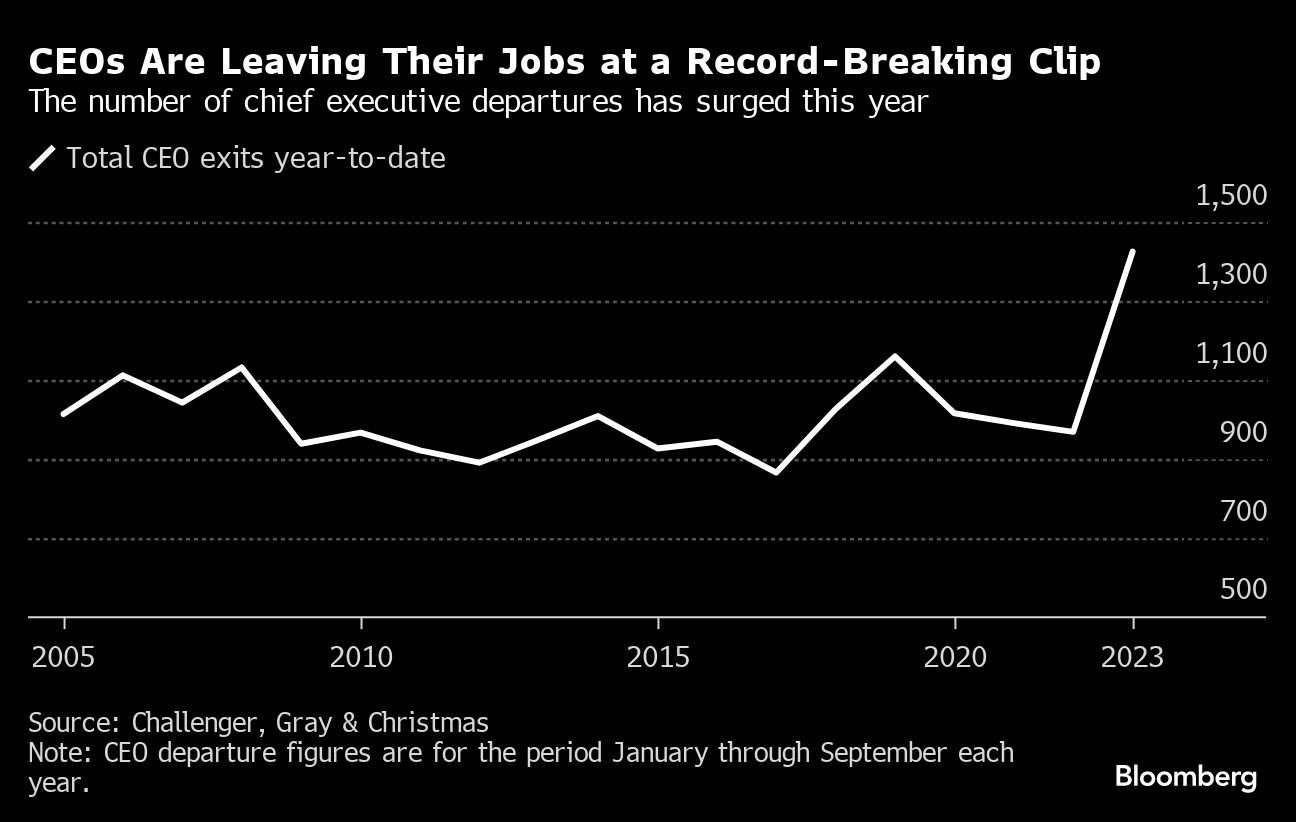
Though no comparable study is available in SA, the trend appears to chime with the US, where 1 425 CEOs quit their jobs in the nine months to September, according to a report by executive coaching firm Challenger, Gray & Christmas Inc. That’s up 47% from the same period last year and the highest on record over that period since the firm began tracking in 2002.
Read: CEO departures hit highest level on record
As expected, companies are coy about the reasons for the departure of their CEOs. In the Challenger CEO Turnover Report, no reason was given for the exit of 31% of CEOs, while 22% retired and 17% “stepped down”.
“Companies are revving up for economic changes in the coming months. With the rise of labour costs and interest rates, companies are looking to new leaders,” Andrew Challenger, a senior vice president at the firm, said in the Challenger report.